How to Write a Product Launch Announcement That Gets Clicks
Founders spend months building their product and minutes writing the launch announcement — then wonder why no one clicked. The problem isn't the product. It's the copy. This guide breaks down the four-part framework that separates announcements that get clicks from the ones that get ignored: the scroll-stopping hook, the benefit-led value prop, the credibility signal, and the single CTA that converts.
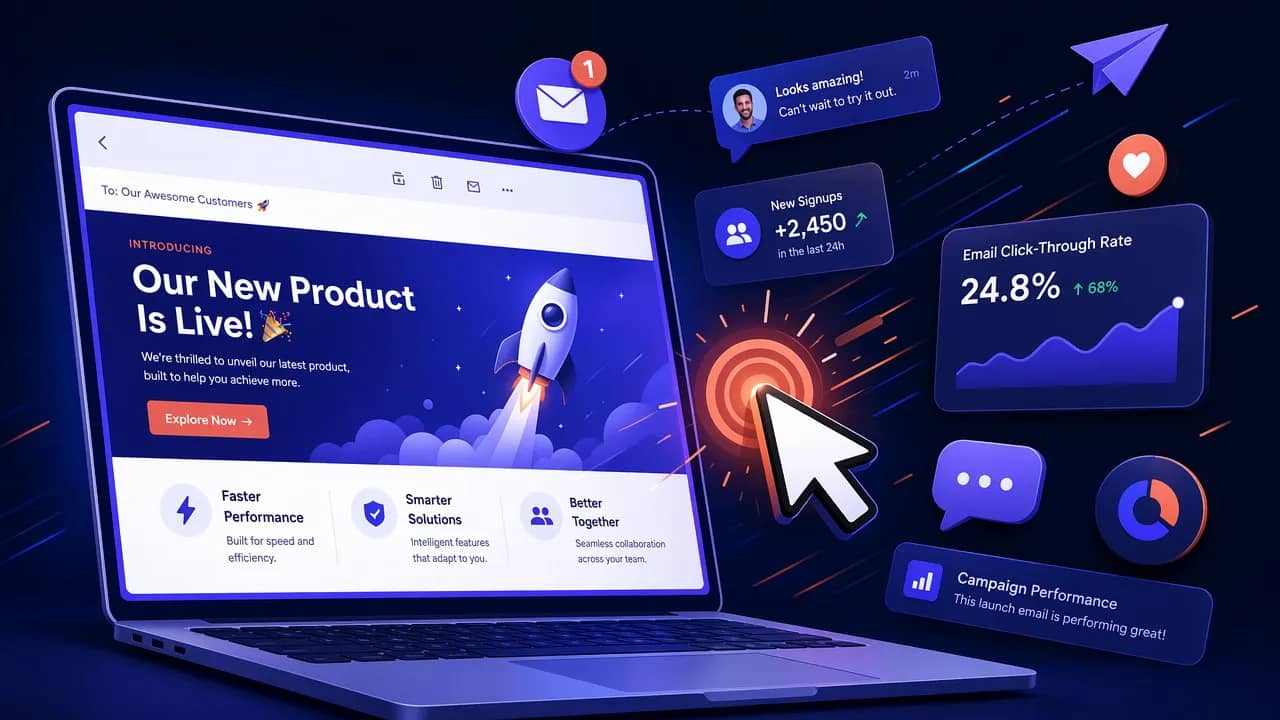
You spent months building your product. You tested it, refined it, and finally felt ready to share it with the world. Then you wrote the announcement in twenty minutes — and wondered why no one clicked.
This gap is more common than most founders realize. A weak announcement doesn't just underperform — it buries the momentum you worked so hard to build. The good news: writing a click-worthy product launch announcement isn't about clever wordplay. It's about clarity, relevance, and meeting your reader exactly where they are.
Why Most Launch Announcements Fail
The default approach looks like this: announce the product, list the features, add a link, and hope for the best. The result reads like a changelog — informative, perhaps, but rarely compelling.
The reader's question is immediate: "What does this do for me — and why now?" Most launch announcements never answer it. Founders write for themselves — celebrating the milestone, explaining the journey, detailing the build — when readers want to know what changes for them.
Two root causes drive this. First, feature-first writing mistakes description for persuasion. Second, founders bury the most important point under too much backstory. Fix both and you've already written a stronger announcement than most.
The Anatomy of a Click-Worthy Product Launch Announcement
Every high-performing launch announcement shares four structural components. Each one earns its place.
Start With a Hook That Stops the Scroll
The first sentence determines whether anyone reads the second. A strong hook reframes a familiar problem or makes a specific, surprising claim. Compare these two openings:
Weak: "Today we're launching our new project management tool."
Strong: "Your team doesn't need another project manager. It needs one that disappears when the work is done."
The second creates tension, implies a benefit, and raises a question the reader wants answered. Write your hook last — once you know what the core message is, you'll craft a sharper opening.
Lead With Benefits, Not Features
Features describe what your product is. Benefits describe what it does for the reader. Apply the "so what?" test: keep asking until you reach the outcome the reader actually wants.
"Automated onboarding flows" is a feature. "New users hit their first success moment 60% faster" is a benefit. One sentence, one promise. Compound value propositions dilute impact — and readers who feel overwhelmed do nothing. Avoid adjective overload. Words like "powerful," "seamless," and "intuitive" appear in every announcement and mean nothing. Replace them with specifics.
Add a Credibility Signal
Social proof at launch is harder to produce but not impossible. Beta results, waitlist numbers, a specific problem you've personally validated — all of these work. Even a concrete detail like "tested with 40 early users over six months" creates more trust than vague expertise-signaling language. Your reader doesn't need you to be famous. They need to believe you've thought deeply about a problem they recognize.
Close With One Clear Call to Action
Multiple CTAs fracture attention. Pick one and make it count. Your CTA should state the action and the immediate outcome — not just the next click.
"Submit your product and get in front of early adopters" beats "Learn more." The first tells the reader exactly what happens next. The second asks them to work for it.
Tailor Your Announcement to the Channel
The same copy rarely performs equally across every platform. The medium shapes the message.
On launch platforms like Pro Launch, your tagline does the heaviest lifting. Prioritize clarity and searchability over wit. Your description should answer three questions: what it is, who it's for, and why now.
In email, the subject line is your hook. Open with empathy rather than excitement — your reader's inbox is already full of founders celebrating themselves. Keep the body to three or four tight paragraphs and drive everything toward the single CTA.
On social media, the first two lines must work without expansion. Most feeds truncate previews and readers scroll fast. LinkedIn tolerates narrative; X rewards compression. Know the difference and write accordingly.
The One Mistake Even Strong Founders Make
They announce the product instead of the outcome. Readers don't share products — they share ideas that make them look insightful or solve a problem others recognize.
Run this test: replace every "we" with "you" and see if the copy gets stronger. It almost always does. The shift in pronoun signals a shift in perspective — from founder milestone to reader benefit — and that's the shift that drives clicks.
Write for Your Reader, Then Put It in Front of Them
A great product launch announcement is a reader service, not a self-promotion exercise. Hook with a specific opening. Deliver one benefit-led promise. Back it with credibility. Close with a single, frictionless action.
Getting the copy right is half the equation. The other half is distribution — putting your announcement in front of people who are actively looking for what you've built.
Submit your product to Pro Launch and reach founders, indie hackers, and early adopters ready to discover your next launch.


