How Indie Tools Actually Get Discovered in 2026 (What Our Launch Data Shows)
Discovery in 2026 is not one channel. It is a launch that puts you in front of early adopters, a short list of directories that people and engines actually read, a homepage written as an answer an AI can quote, one or two communities, a couple of newsletters, and search pages that pay off months later. None of them is big for a new product. Together they make it likely that someone hears about you twice, and that is usually when they click.
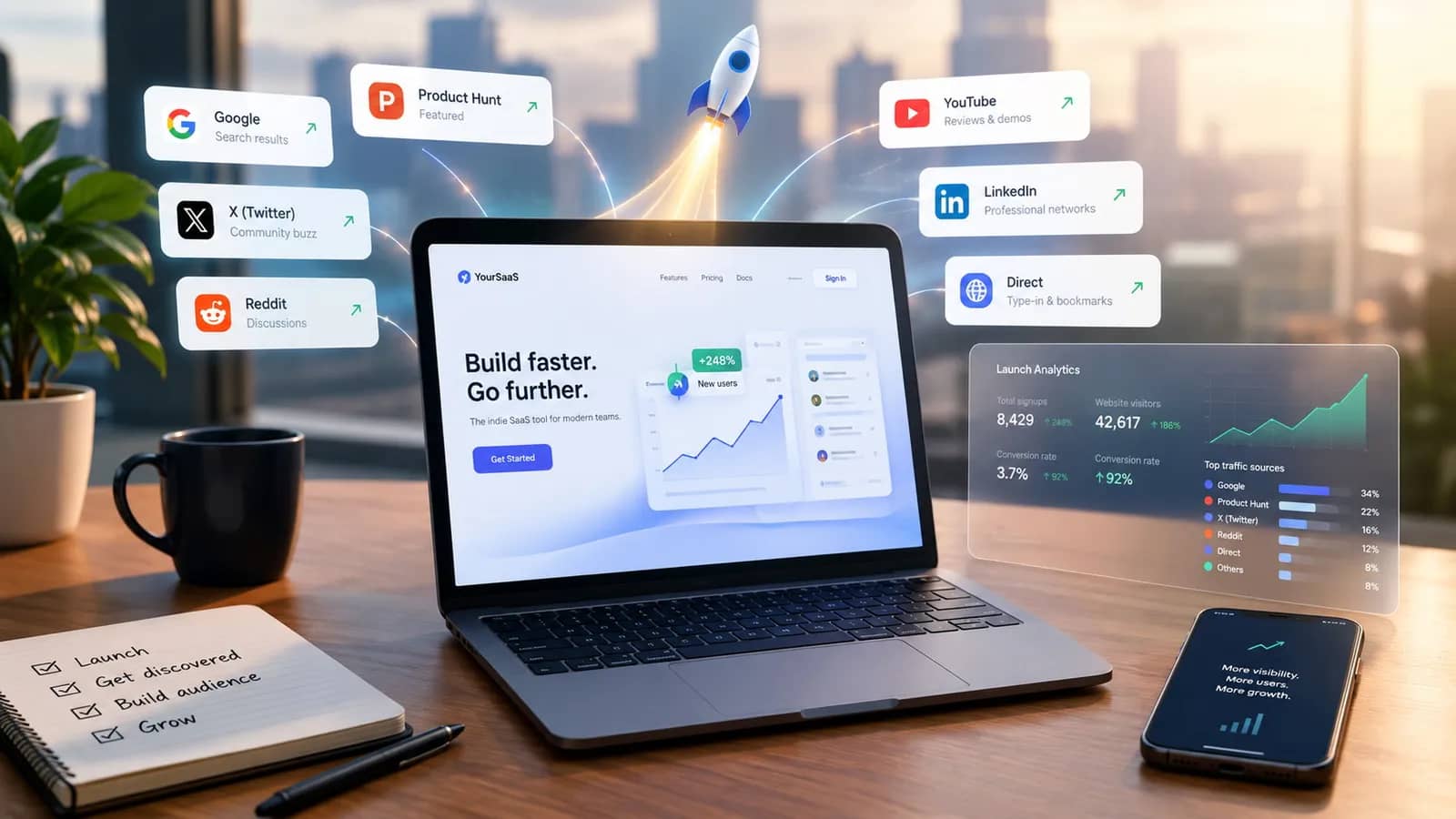
Coding got cheap. Being found did not. Every week a couple of hundred builders submit products to Nick Launches, and the question I hear most is not how to launch. It is where the people come from afterwards. I have three sets of numbers that answer it better than my opinion does: our own traffic, our weekly launch board, and a catalog of 192 launch directories we measure every month, including how often AI engines name each one. Here is what they say about discovery in 2026, and what I would do in the first four weeks after a launch.
Discovery is a dozen small channels now
Start with our own traffic, because a directory is a product that has to get discovered too. In the 30 days to October 5, visits to Nick Launches arrived from more than 800 different sources. 44% were direct: people coming back, or opening a link someone sent them. X brought 8%. Google organic search brought 6%. Email brought 3%. ChatGPT, the channel everyone is writing about, brought about half a percent. Referrals made up 18%, spread across a long list of other launch sites, newsletters and product pages, none of them big on its own.
That is the shape of discovery for anything young. No single channel carries you, and the biggest bucket is people who already heard of you somewhere else. The job in the first weeks is not to find the one channel that works. It is to show up in enough small ones that the same person hears about you twice.
Launch platforms: the day versus the week
A launch platform is still the fastest way to put a new product in front of people who browse new products on purpose. The odds have changed, though. Product Hunt featured 655 of 15,688 launches in the last 30 days, about 4%, according to hunted.space's Product Hunt Pulse. In 2013 it featured 88%. A day on the front page is now a selection process, and a builder without an audience walks into it cold.
Our board runs by the week, and the latest one shows what actually decides a launch. 230 products were submitted, 108 went live in their launch window and the board took 1,219 upvotes, a record. The top free launch finished with 28 votes, more than three of the four featured launches that week. A featured slot gets you seen. What turns that into votes, comments and visits is still the people you bring and how clearly your page says what the product does.
So choose launch platforms by launch model first. If you have a following, a daily board gives you a day to win. If you do not, a weekly board or a permanent project page gives you time to bring people in, and a listing that keeps working after the spike. Pro Launch's own directory submission checklist covers the preparation side well, so I will stay on where the attention comes from.
Directories: most are read by nobody, a few by everyone
Directories are the channel with the widest gap between looking useful and being useful. Across the 192 launch directories in our catalog, the median gets about 1,800 visits a month. 46 have never been named in an AI answer in our data (Google AI and ChatGPT, US English). The top ten carry 80% of all the AI mentions in the catalog.
That concentration is the whole story. A small group of sites with real profile pages and reviews, such as G2, Capterra, Crunchbase, SourceForge, AlternativeTo and Product Hunt, are read constantly by people and by the engines that answer their questions. Hacker News alone was named 41,347 times in the AI answers in our data. The long tail is mostly pages nobody visits and no engine reads. Twenty listings on directories that get read beat two hundred on directories that do not.
AI answers: small traffic, high intent, and your own site is the source
AI answers are the channel that grew up this year, and the conversion numbers explain why builders care. Ahrefs reported that AI search brought about 0.5% of its visits but about 12.1% of its signups. People who arrive from an answer arrive with the decision half made.
What ChatGPT cites also moved this summer. Promptwatch measured Reddit's share of ChatGPT citations falling from 3.83% to 0.52% after August 8, while the share of background searches scoped to a single site jumped from 0.37% to 16.8% in one day. And being found is not the same as being cited: AirOps watched ChatGPT retrieve 548,534 pages across 15,000 prompts and cite only 15% of them.
We checked this on one of our own products, promptbuilder.cc. 73 AI answers named it, 54 in Google AI and 19 in ChatGPT. The most cited source in those answers was promptbuilder.cc itself, followed by Reddit and YouTube. No launch directory made its top ten sources, even though the product is listed on more than a hundred. Directories help an engine find you and file you under the right category. The citation itself usually goes to the page you own. I wrote up the mechanics, including the crawler setting that quietly locks a lot of sites out, in what ChatGPT actually cites now.
Search: still the compounding channel, just slower to pay
Google is still where intent lives, but the click is smaller than it was. Pew Research found that users who saw a Google AI summary clicked a traditional result in 8% of visits, against 15% without one, and clicked a link inside the summary in just 1%. For a new product, search is a months-long project, not a launch-week one. Our own 6% from organic search tells the same story: it compounds, but it is not where the first wave comes from.
When search does pay, it pays the pages that answer one question well: a comparison, an alternatives page, a pricing page with real numbers. Write those in month one, so they are old enough to rank by month four.
Communities and newsletters: borrowed audiences that already trust someone
Communities and newsletters work for the same reason. Someone else already earned the attention, and you get introduced into it. Reddit losing weight in ChatGPT citations does not make Reddit useless; it means a thread is now a way to reach people, not a way to reach a model. Pick one or two communities where your buyers already ask questions, answer for weeks before you mention the product, and let it come up when it is the answer.
Newsletters are the quieter version. Our weekly recap went to 3,612 subscribers last week, 270 more than the week before, and a product featured in it gets read by people who opened an email on purpose. Pitch the curators who cover your category with one sentence on what the product does and one specific reason their readers would care. And start your own list on day one, because every other channel in this piece is rented.
The first four weeks, in order
Before launch: make sure engines can read you. Check that your CDN or bot settings are not blocking search crawlers, and rewrite the first paragraph of your homepage as the answer: what it is, who it is for, what it costs, and the one number that proves it works.
Week one: one ranked launch you can actually show up for, on a platform whose launch model fits your audience. Reply to every comment the same day.
Week two: list on the directories that get read, the ones with real traffic and AI mentions, plus the category directories for your niche. Use the same product name and one-line description everywhere, because consistency is how an engine recognizes a product it has never seen before.
Week three: one community and two newsletter pitches. Publish one comparison or alternatives page on your own site.
Week four: measure. Ask ChatGPT, Perplexity and Google AI Mode the five questions your buyers ask, and write down what they name and which sources they cite. Check the AI assistant channel and the referral list in GA4. Keep the two or three channels that sent people who signed up, and drop the rest.
About the author: Nick is the founder of Nick Launches, a discovery directory where builders list their indie products, get a listing with a backlink and reach daily visitors. He publishes a weekly launch board and a free tracker of 192 launch directories that measures how often AI engines name each one.