The Complete Startup Launch Day Checklist: Everything You Need to Launch With Confidence
A practical startup launch day checklist to help founders test the customer journey, prepare launch assets, monitor issues, and turn early feedback into growth.
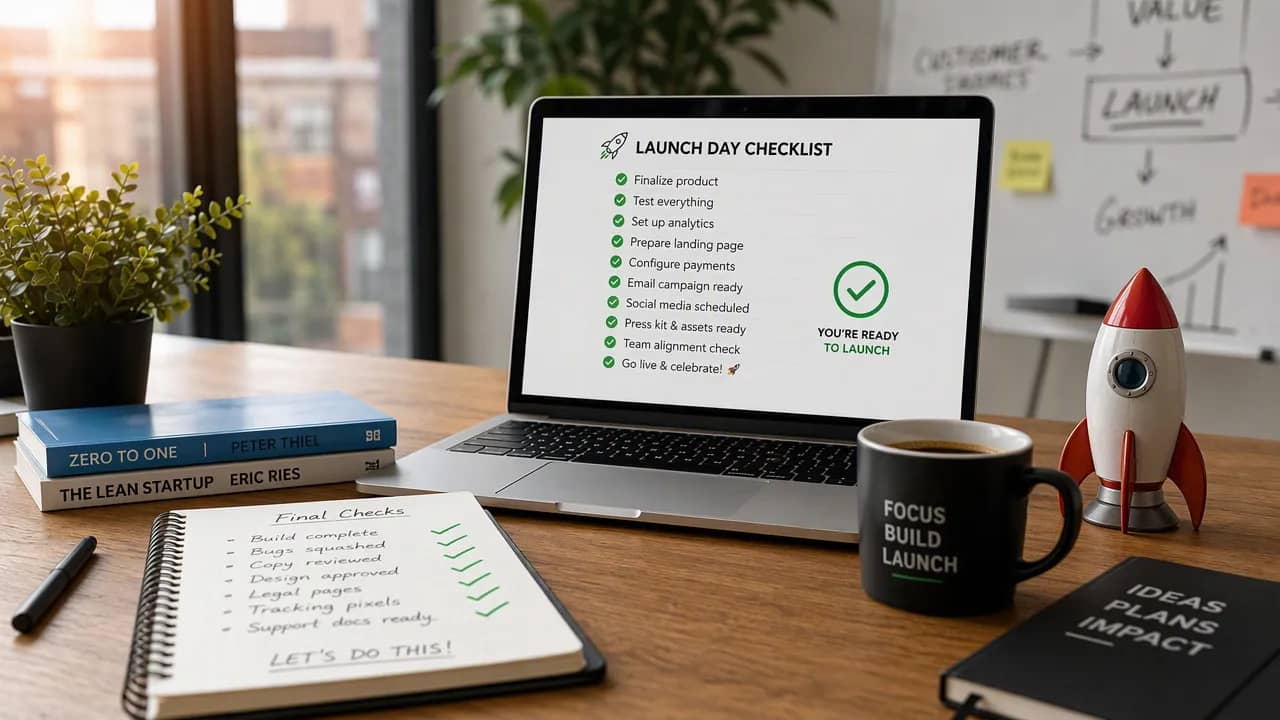
Launch day can feel like opening the doors to a shop while you’re still checking whether the lights work. Your product may be ready, your site may look sharp, and your social posts may be scheduled. But a startup launch only works when the product, message, support, and measurement all hold together.
This startup launch day checklist helps you cover the work that actually matters before attention arrives.
Define What “Launch” Means Before You Start Promoting
Not every startup needs the same kind of launch. A public product announcement, a waitlist campaign, a paid-plan release, and a Product Hunt launch each demand different goals and resources.
Write one sentence that defines the event. For example: “We are launching our AI workflow tool to acquire 100 qualified trial users from small marketing teams.” That statement keeps the team focused when ideas start flying around.
Then decide what success looks like. Avoid vague goals such as “get visibility” or “build buzz.” They sound good in a planning call but give you nothing useful to measure afterward.
Set a small group of targets instead:
New sign-ups or waitlist registrations
Activated users who reach the product’s first useful action
Trial-to-paid conversions
Demo bookings
Revenue generated
Landing-page conversion rate
Support requests and technical errors
Customer feedback themes
Traffic matters, of course. But 10,000 visitors who leave in five seconds are less useful than 50 people who understand the product and want to use it.
Test the Entire Customer Journey Like a First-Time User
Founders know their own products too well. That’s the problem.
You know what every button does, where the settings live, and which workaround solves an unfinished flow. A new visitor knows none of that. They arrive with a question, a little patience, and plenty of alternatives.
Before your product launch day, test the complete journey from the outside:
Visit the landing page from a private browser window.
Click the main call to action.
Create an account with a fresh email address.
Verify the email.
Complete onboarding.
Test the core feature.
Check payment, trial, and cancellation flows.
Review every confirmation email and support link.
Do this on mobile as well as desktop. Test common browsers. And get someone outside the product team to try it without guidance. If they hesitate, get lost, or ask a basic question, treat that moment as evidence—not as user error.
The first-value moment should be fast and obvious. A customer needs to see the promised outcome before their attention disappears.
Complete the Technical Startup Launch Checklist
Launch traffic creates pressure. A small defect that seems harmless during internal testing can become a public mess when hundreds of people encounter it at once.
Your technical launch checklist should confirm that the basics work under real conditions:
Production hosting and domain settings are live
SSL certificates are valid
Forms send submissions to the correct inbox or CRM
Analytics events fire correctly
Error logging and uptime monitoring are active
Transactional emails arrive reliably
Payment gateways process purchases and issue confirmations
Database backups are current
A public status page or support update channel exists
You also need a rollback plan. If a deployment breaks account creation or payment, who has authority to pause the campaign? Who can revert the change? Where are vendor contacts, credentials, and escalation details stored?
Keep that information in one shared document. Launch day is not the time to dig through old messages looking for a payment-provider login.
Make Your Offer Easy to Understand
People should not have to decode your startup’s value proposition.
Your homepage, launch page, email, and social posts should answer four questions quickly:
Who is this for?
What problem does it solve?
How does it work?
What result can the customer expect?
Features matter, but they rarely carry the message alone. “AI-powered reporting dashboard” explains what you built. “Turn scattered campaign data into a client-ready report without hours of spreadsheet work” explains why someone should care.
Keep pricing equally clear. State what each plan includes, whether a trial applies, and what happens after that trial ends. Hidden conditions may increase short-term clicks, but they create support burden and distrust later.
If you are offering a launch discount, give it a clear deadline and simple terms. Don’t make people hunt for the catch.
Prepare Launch Communications for Each Channel
A startup launch communications plan should not rely on one generic post copied across every channel. Your email subscribers already know something about you. A niche online community may not know you at all. The context changes.
Prepare channel-specific launch assets in advance:
A dedicated launch landing page
A concise founder announcement
Email copy for subscribers or waitlist members
Social posts with product visuals
Product screenshots or a short demonstration
Community posts tailored to relevant groups
A press or partner brief, where appropriate
A practical FAQ
Customer support responses for common questions
For a public launch platform or founder community, lead with the problem and the product’s practical difference. Avoid chest-thumping language. People can smell “revolutionary” from a mile away, and honestly, they’re tired of it.
Services such as Pro Launch can help founders build visibility through structured launch promotion. Still, promotion works best when the destination page, message, and onboarding are already solid.
Run Launch Day in Clear Operating Blocks
On launch morning, begin with a short team check-in. Confirm that the site is live, analytics work, support coverage is available, and every campaign link leads to the right place.
Then publish your primary announcement.
From there, work in focused blocks. Don’t spend the entire day refreshing social metrics. Review the product experience, answer questions, track traffic quality, and watch for errors.
Assign ownership before the day begins:
Founder or spokesperson: Public updates, major customer conversations, partner outreach
Technical owner: Stability, bugs, monitoring, deployments
Support owner: Inbox, live chat, FAQs, issue triage
Marketing owner: Distribution, community engagement, campaign performance
Metrics owner: Funnel tracking and launch reporting
A simple incident system keeps the team calm. Label problems as critical, major, or minor. Critical issues block sign-up, payment, or core use. Fix those first. A typo in a secondary page can wait.
And if something breaks, say so plainly. A fast, clear update beats silence every time.
Treat Feedback as Your Most Valuable Launch Asset
The first customers will show you where the product and message fall apart. That can sting. It’s also the point.
Track recurring questions. Note where visitors leave the funnel. Save exact phrases customers use to describe their problem and your product. Those words often improve future copy more than a long internal brainstorming session.
Within 48 hours, review:
Which channels produced qualified visitors
Where users abandoned onboarding
Which objections appeared most often
What support issues slowed customers down
Whether activated users returned after their first session
Then turn those findings into an action list. Fix the issues that block value first. Follow up with high-intent leads. Thank early users. Keep shipping.
A launch is not the finish line. It is the first honest conversation between your startup and the market.


